OdonAssist is CE marked and can only be sold in countries that recognize the CE mark. It is not available for sale in other countries and jurisdictions until local regulatory approvals and clearances have been obtained.
Gently assisting childbirth
What is “assisted vaginal birth?”
Assisted vaginal birth is when your obstetric team – in an instance where there is a medical reason to do so -- supports the final stage of birth, helping your baby to be born vaginally.
The OdonAssist™ device is the first breakthrough innovation in assisted birth in more than a century21, and has been shown in clinical studies to be safe3-5 and gentle.4-6
1
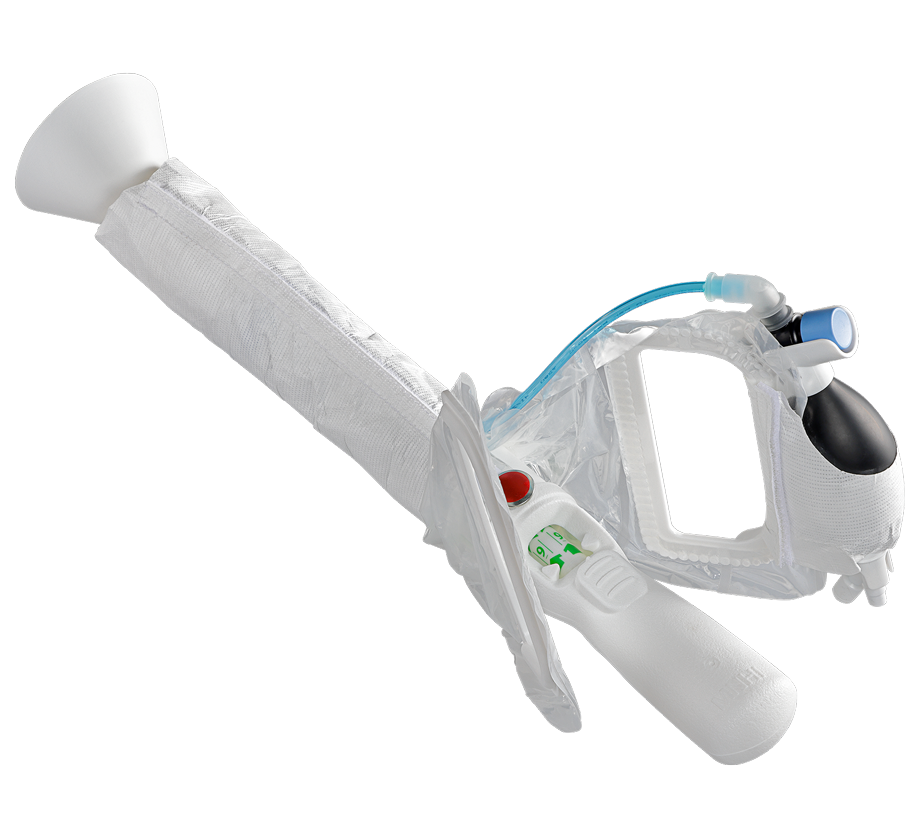
Applicator guides the placement of soft air cuff
2
Soft air cuff secures around your baby’s head
Gentle by design
The OdonAssist device is a new choice for assisting birth. Its soft, inflatable design features an air cuff that secures around the baby’s head*, allowing clinicians to apply gentle controlled traction during birth.
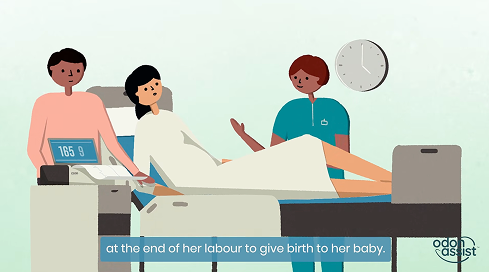
During childbirth your obstetrician uses the OdonAssist device together with you, guided by your own pushing and contractions…a partnership between you and your care team, working in rhythm with your body.
* Some women have voiced concerns that this technique may interfere with how their baby breathes. However, at the stage of labour when the OdonAssist device is used, your baby is getting all of their oxygen and nutrients from your placenta.
See how it works
More than
95%
of babies experienced no or low pain from childbirth4,5
All
mothers reported a positive experience with the OdonAssist device4
0%
no typical pattern of device-related neonatal injury or bruising4,5
Is it an option for me?
Whether the OdonAssist device is right for your birth is a decision made together with your obstetric care team based on your individual circumstances. It isn't the right choice for every birth -- your care team will talk you through your options in the event assistance is needed.
What mothers are saying
“The OdonAssist device completely delivered on its promise.”26
“After all the hard work of labour it was great to still feel like I was delivering my baby.”26
“I want other moms to know there is an option called the OdonAssist which is gentle compared to other methods.”27
“I’m glad I did it. I wouldn’t want it any other way.”27
Watch: “A Mother’s Story”
Watch: “Clinicians’ Story”
Putting women at the heart of what we do is a key part of our mission to bring about change in maternity care.
Your questions answered
Where is the OdonAssist device available?
At this time the OdonAssist™ device is available and in use in certain European countries. Maternity hospitals in Austria, Belgium, France, Germany, Italy, Spain and the United Kingdom are using the OdonAssist device in clinical practice. We plan to expand access to additional countries over the coming months and years. The best way to find out if the OdonAssist device is available where you're planning to give birth is to ask your obstetric and midwifery care team.
Why was the OdonAssist device developed?
Currently available methods to assist childbirth – forceps, vacuum and caesarean section - are known to have risks which can lead to unnecessary pain, trauma, and short and long-term complications.1-2,7 The OdonAssist™ is designed as a new, gentle4-6 alternative for assisted vaginal birth that is safe for mothers and newborns.3-5
Is the OdonAssist device safe?
Yes. The OdonAssist™ device is designed to support safe outcomes during assisted vaginal birth. For your baby, the device causes no typical pattern of bruising or injury that commonly occurs with the use of forceps or vacuum4,5. And in clinical trials, there were no serious maternal adverse reactions related to the device3-5.
How is the OdonAssist device different from vacuum/ventouse?
The OdonAssist device, ventouse and forceps are all methods that can be used to assist a vaginal birth in the final stages of labour. Your obstetric team will recommend the most appropriate option based on your individual circumstances.
The main difference is how each device supports your baby’s birth.
The OdonAssist device uses a soft air cuff that fits around your baby’s head. Once positioned, the air cuff is inflated to create a gentle hold around the head. Your clinician can then use traction, together with your contractions and pushing, to help your baby’s birth.
Ventouse refers to vacuum-assisted birth which uses a small cup placed on your baby’s head, with suction created to help guide your baby through the birth canal. Your clinician uses traction, together with your contractions and pushing, to help your baby’s birth.
Forceps are curved, rigid instruments that are placed on either side of your baby’s head. Your clinician uses them to guide your baby’s head while you continue to push.
Unlike ventouse, the OdonAssist device does not use suction on your baby’s head. Unlike forceps, it does not use rigid metal instruments around your baby’s head.
Every assisted vaginal birth is different. Your clinician will consider your and your baby’s individual circumstances, explain the options available to you and involve you in decisions about your care.
Will I still need to push?
Yes. When the OdonAssist device is used, you will still need to push with your contractions.
The device is designed to assist with the birth of your baby, but it does not replace your efforts. Your midwife or obstetrician will guide you on when and how to push while the OdonAssist device is used to provide additional assistance during the birth.
Will I need pain relief?
Every birth is different, and the amount and type of pain relief you may want or need will depend on your individual circumstances and preferences.
There is no single type of pain relief that is right for everyone. Births have been performed with the OdonAssist device with and without pain relief. The use of pain relief medication is a decision to be made between you and your care team.
What happens if I am not able to birth my baby with the OdonAssist device?
If the OdonAssist™ device does not help you birth your baby it can be removed easily, allowing for other interventions4-5. Your maternity team will assess and discuss with you what they feel would be the appropriate next steps for you and your baby.
Can I include the OdonAssist device in my birth preferences?
Yes. If you would like to consider the OdonAssist device should you need an assisted vaginal birth, you can include this in your birth preferences and discuss it with your maternity team during pregnancy.
However, whether the OdonAssist device can be used will depend on the circumstances at the time. Your healthcare professional will assess you and your baby and consider whether an assisted vaginal birth is appropriate and, if so, which method is safest and most suitable for you and your baby.
Your preferences are important and should be part of the conversation, but the final decision will always be based on your individual clinical situation at the time of birth.
The data behind the OdonAssist device
Key Results
1
In a clinical trial, women and midwives articulated views suggesting the common belief that forceps are more ‘traumatic’ either physically or emotionally.6
2
In a clinical trial, midwives perceived that the OdonAssist™ is kinder than other devices and described the births as ‘softer’, ‘nicer’, ‘beautiful’, ‘easy’, ‘smooth’ and ‘gentle’.6
3
In all clinical trials OdonAssist™ was demonstrated to be safe for the baby3-5, with no typical pattern of the neonatal bruising or injury that can result from the use of other assisted vaginal birth devices.4,5
4
The efficacy (successful assisted birth) rate with OdonAssist™ in clinical trials was up to 88.5%.5
5
If OdonAssist™ does not deliver the newborn it can be removed easily, allowing for other interventions.4-5
6
Unlike forceps and vacuum extraction, with OdonAssist™ the insertion technique is the same for all fetal head positions in cephalic vertex presentations3-5 (your baby is positioned head-down with the crown of the head leading into the birth canal).
Published research & press
Data, evidence and expert opinion about the OdonAssistTM device have been published in more than 20 medical publications. View the most current here.
By using this website, you agree to the storing of cookies on your device to enhance site navigation, analyze site usage, and assist in our marketing efforts. View our Privacy Policy and Cookie Policy for more information.